
 Ultimatecarpage.com
> Cars by brand
> Italy
> Ferrari
Ultimatecarpage.com
> Cars by brand
> Italy
> Ferrari
 Daytona SP3 Daytona SP3
|
| Ferrari Daytona SP3 |
| Article | Image gallery (56) | Chassis (3) | Specifications |
|
|
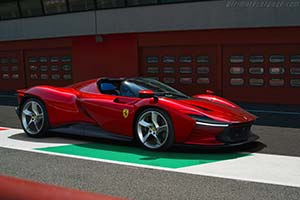
<< Prev Page 2 of 3 Next >>  Although inspired by the stylistic language of 1960s racing cars, the Daytona SP3 is clothed in very undeniably original, modern forms. Its sculptural power celebrates and interprets the sensual volumes of sports prototypes to wholly contemporary effect. It goes without saying that a design this ambitious demanded a meticulously planned and executed strategy from Chief Design Officer Flavio Manzoni and his Styling Centre team. Although inspired by the stylistic language of 1960s racing cars, the Daytona SP3 is clothed in very undeniably original, modern forms. Its sculptural power celebrates and interprets the sensual volumes of sports prototypes to wholly contemporary effect. It goes without saying that a design this ambitious demanded a meticulously planned and executed strategy from Chief Design Officer Flavio Manzoni and his Styling Centre team.From the wraparound windscreen back, the Daytona SP3’s cabin looks like a dome set into a sensual sculpture with sinuous wings emerging boldly either side. The car’s overall balance is underscored by monolithic volumes that are a powerful articulation of the long-appreciated skills of Italian coachbuilding at its finest. The fluidity of its masses melds effortlessly with sharper surfaces, to produce the sense of effortless aesthetic balance that has long been a signature of Maranello’s design history. The clean double-crested front wings are a nod to the sculptural elegance of past Ferrari sports prototypes of the likes of the 512 S, 712 Can-Am and 312 P. The shape of the wheelarches efficiently connotes the geometry of the flanks. At the front, they are structural and create a powerful link between wheel and well by not completely following the circular profile of the tyre. The rear flank swells out from the sylph-like waist giving rise to a powerful rear muscle that wraps around the front of the wheels, then tapers back towards the tail, lending a powerful dynamism to the three-quarter view. Another key element is the butterfly doors, which have an air box integrated into them to channel air to the side-mounted radiators; the resulting sculptural forms give the doors a pronounced shoulder housing the air intake that is visually linked to the vertical cut of the windscreen. The pronounced surface of the doors, whose leading edge forms the rear of the front wheelarch, also helps to manage the airflow emerging from the front wheels. This surface treatment also closely recalls that of cars such as the 512 S which partly inspired the Daytona SP3’s stylistic code. The wing mirrors have been moved ahead of the doors to the top of the wings, recalling again the sports prototypes of the 1960s. The position was chosen to provide better visibility and reduce the impact of the wing mirrors on the air flow to the door intakes. The shape of the mirror’s cover and the stem were perfected via dedicated CFD simulations to ensure an uninterrupted flow to the intakes. That said, the three-quarter rear view of the car is even more significant as it fully reveals the Daytona SP3’s original styling. The door is a sculpted volume, which generates a pronounced dihedral form. Together with the powerful muscle of the rear wing, it creates a completely new, pinched-waist look. The door acts to extend the surface of the front wheelarch and counterbalances the imposing rear, visually transposing the volume of the flank and lending the car a more cab-forward look. The location of the side radiators allowed this architecture to be adapted to suit a sports car. The front of the Daytona SP3 is dominated by two imposing wings that feature outer and inner crests: the latter dive into two air vents on the bonnet, making the wings look wider. The relationship between the perceived mass created by the outer crest and the aerodynamic role of the inner one underscores the way in which styling and technology are inextricably linked in this car. The front bumper has a generous central grille framed by two pillars and a series of stacked horizontal blades framed by the outer edge of the bumper. The headlight assemblies are characterised by an upper mobile panel that recalls the pop-up headlights of early supercars, a theme dear to Ferrari tradition that lends the car an aggressive, minimalist look. Two bumperettes, a reference to the aeroflicks featured on the 330 P4 and other sports prototypes, emerge from the outer edge of the headlights, adding a further expressiveness to the front of the car. The rear bodywork highlights the powerful appearance of the wing by the repetition of the twin-crest theme and the aerodynamic vent that boosts its three-dimensional volume. The compact, tapered cockpit combines with the wings to create a powerful tail with a central backbone element inspired by the 330 P4. The naturally-aspirated V12, the living beating heart of the new Ferrari Icona, is revealed in all its glory at the end of this backbone. A series of horizontal blades complete the rear, creating the impression of a light, radical, structured monolithic volume that lends the Daytona SP3 a look that is both futuristic and a nod to signatures from Ferrari’s DNA. The taillight assemblies are made up of a horizontal luminous bar beneath the spoiler and integrated into the first line of blades. The twin tailpipes are positioned centrally in the upper part of the diffuser, adding to its aggressive character and completing a design that visually broadens the car. Even the Daytona SP3’s cockpit takes its inspiration from historic Ferraris such as the 330 P3/4, the 312 P and the 350 Can-Am. Starting with an idea of a high-performance chassis, the designers crafted a meticulously refined space that delivers the comfort and sophistication of a modern Grand Tourer whilst keeping the styling language quite minimalist. It retains the philosophy behind certain styling codes: the dash, for instance, is minimalist and functional yet also entirely contemporary in feel. The typical upholstered cushions that were directly attached to the chassis on sports prototypes have been transformed into modern seats integrated into the body, creating a seamless textural continuity with the surrounding trim. Several exterior elements, including the windscreen, positively influenced the interior architecture. Seen from the side, the cut of the windscreen header rail creates a vertical plane that divides the cockpit in two, separating the functional area of the dashboard that hosts the instrumentation from the seating. This architecture neatly executes the difficult feat of being both extremely sporty and very elegant at the same time. The Daytona SP3’s interior aims to guarantee both driver and passenger a snug driving environment by drawing on styling cues typical of competition cars. The main idea was to broaden the cabin visually by creating a clear break between the dash area and the two seats. The latter, in fact, are part of a seamless textural continuity, their trim extending all the way to the doors, reproducing the elegant functionality typical of sports prototypes. This same extension of the trim can also be seen on the sill area when the doors are open. The dashboard follows the same philosophy: here the Daytona SP3’s structure means that the trim extends all the way to the quarterlights, hugging the entire area connecting with the windscreen. The slender, taut dashboard seems almost to float within the upholstery. Its styling theme develops on two levels: the upper trimmed shell, which has a clean, sculptural look, is separated from the lower one with a clear textural and functional dividing line. All of the Human-Machine Interface (HMI) touch controls are clustered below this line. The seats are integrated into the chassis and thus have the ergonomic wraparound design typical of high-performance cars, but also the kind of meticulous detailing that sets them apart. The textural connection between the seats and the extension of the theme to the adjacent trimmed areas, as well as certain volumetric effects, were possible because they are fixed, while the driver’s adjustments are taken care of by an adjustable pedal box. The clear break between the technical area of the cockpit and the occupant area also allowed the seat volume to be extended all the way to the floor. Even the headrests reference their competition counterparts, but while in the latter they are integrated into single-piece seats, in the Daytona SP3 they are independent. The fixed seat and adjustable pedal box architecture meant they could be anchored to the rear trim, thus also helping to visually lighten the cockpit. The door panel design also helps to visually widen the cockpit. Some trimmed areas have been added to the carbon-fibre panels: leather padding on the door panel at shoulder height strengthens the connection with sports prototypes and further accentuates the wraparound effect. Lower down, however, the surfaces feel like an extension of the seat itself. The tunnel has a signature blade set beneath the connecting trim between the seats, with its functional elements at its extremities. In its front section is the gearshift gate reintroduced to the range on the SF90 Stradale. Here, however, it is raised and feels almost suspended over the volumes around it. The structure ends in a carbon-fibre central pillar that seems to support the entire dash. To give the Daytona SP3 the most exhilarating V12 on the market, Ferrari chose the 812 Competizione’s engine as its starting point, but relocated it to the mid-rear position to optimise the intake and exhaust layout as well as fluid-dynamic efficiency. The result is that the F140HC engine is the most powerful internal combustion engine ever built by Ferrari and deliver a massive 840 cv with the typical exhilarating power and sound of a Prancing Horse V12. The engine has a 65° vee between its cylinder banks and retains the 6.5-litre capacity of its predecessor, the F140HB, sported by the 812 Competizione from which it inherits its upgrades. All the developments enhance the performance of a powertrain that sets the new benchmark for its category thanks to its astonishing soundtrack – obtained through targeted work on both the intake and exhaust lines – and the 7-speed gearbox, which is now even faster and more satisfying than ever thanks to the development of specific strategies. Maximum revs of 9,500 rpm and a torque curve that rises rapidly all the way up to maximum revs gives occupants the feeling of boundless power and acceleration. Particular attention was lavished on reducing the engine’s weight and inertia by adopting titanium con rods, which are 40% lighter than steel, and the use of a different material for the pistons. The new piston pins have a Diamond Like Carbon treatment (DLC), which reduces the coefficient of friction to improve performance and fuel consumption. The crankshaft has been rebalanced and is now also now 3% lighter. Valve opening and closing is by way of sliding finger followers, derived from F1 and developed with the aim of reducing mass and availing of more high performance valve profiles. The sliding finger followers also feature DLC coating and their function is to transmit the action of the cam (again with DLC coating) to the valve using a hydraulic tappet as the pivot for its movement. The intake system has been radically redesigned: the manifold and the plenum are now more compact to reduce the overall length of the tracts and deliver power at high revs, while the torque curve is optimised at all engine speeds by a system of variable geometry inlet tracts. The system enables the length of the intake tract assembly to be continuously varied, adapting it to the engine firing intervals to maximise the dynamic charge in the cylinder. A dedicated hydraulic system governs the actuators and is controlled by the ECU in a closed loop, adjusting the inlet tracts’ length position on the basis of the engine’s load. Combined with optimised cam profiles, the variable valve timing system creates an unprecedented system of equal height pressure peaks required to obtain power at high revs without sacrificing any torque at low and medium revs. The result is a feeling of continuous, rapid acceleration, culminating in astonishing power at maximum revs. The management strategies for the gasoline direct injection system (GDI at 350 bar) have been further developed: it now comprises two petrol pumps, four rails with pressure sensors that provide feedback to the closed loop pressure control system and electronic injectors. Calibration of the timing and amount of fuel injected at each injection, in addition to an increase in injection pressure, have made it possible to reduce polluting emissions and particulate formation by 30% (WLTC cycle) compared to the 812 Superfast. The ignition system is constantly monitored by the ECU (ION 3.1) which has an ion-sensing system that measures ionising currents to control ignition timing. It also has a single and a multi-spark function for when multiple ignitions of the air-fuel mixture are required for smooth, clean power delivery. The ECU also controls combustion in the chamber to ensure that the engine is always working at peak thermodynamic efficiency conditions, thanks to a sophisticated strategy that recognises the octane rating of the fuel in the tank. A completely new variable-displacement oil pump was developed to allow oil pressure to be continuously controlled right across the engine’s entire operating range. A solenoid valve, controlled by the engine ECU in a closed loop, is used to control the pump’s displacement in terms of flow and pressure, delivering only the amount of oil required to guarantee the functioning and reliability of the engine at every point in its functioning. Importantly, in order to reduce friction and improve mechanical performance, a less viscous engine oil than in the previous V12 is being used, and the entire oil scavenge line has been made more permeable to make it more efficient. << Prev Page 2 of 3 Next >> |
| Article | Image gallery (56) | Chassis (3) | Specifications |
| All Cars - Contact us - Privacy Statement - Top | © 1998 - 2026 Ultimatecarpage.com |