
 Ultimatecarpage.com
> Cars by brand
> Italy
> Ferrari
Ultimatecarpage.com
> Cars by brand
> Italy
> Ferrari
 512 TR Spider 512 TR Spider
|
| Ferrari 512 TR Spider |
| Article | Image gallery (12) | 97310 | Specifications |
|
|
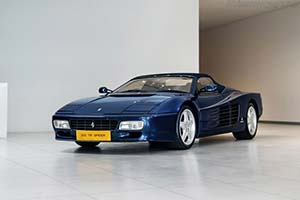
<< Prev Page 2 of 3 Next >>  Red head Red headAt the 1984 Paris Motorshow a legendary name was reintroduced in the Ferrari line-up; 'Testarossa'. It was first used as 'TR' almost thirty years earlier for Ferrari's four and twelve cylinder engined sports-prototype racers. Italian for 'red head', Testarossa referred to the bright red cylinder heads used on the engines. The most famous of these was the multiple 24 Hours of Le Mans winning 250 TR. Technically the Testarossa was almost identical to the 512 BBi it replaced, but on the outside the two were quite different. Functionality was the entire reason why the Testarossa looked so different. The single rear mounted radiator used in the two 'BB' models was replaced by one on either side of the engine. The engine alone was already quite substantial in width, but with a radiator on either side, the complete package needed a two meter wide rear body to house it properly. To accommodate this larger posterior, Pininfarina designed a completely new body. Gone was the sharp wedge-shaped nose and in came a rounder front fascia. The Testarossa's most characteristic exterior features were the radiator intakes which consisted of a set of five louvers on each door. This novelty was later incorporated in many other mid-engined supercars. The front mounted oil cooler was fed air through a small hole in the lip under the left headlight. Various evolutions Another feature typical for early Testarossas was the single wing mirror mounted on the A-pillar. When revised traffic rules recalled for a second mirror, the position of the driver's side mirror was relocated to the more common position at the bottom of the A-pillar. Very little changed through the Testarossa's production life, which lasted until 1991. The first real evolution of the Testarossa came in 1991 when the 512 TR was unveiled. The full Testarossa name was abandoned in favour of TR. Subtle changes were made to the exterior, including a new color coded front lip with two intakes. A final version was launched in 1994 in the form of the F512M. The M was for Modificato, Italian for modified. The most notable change was the replacement of the pop-up headlights with standard body-molded fixed units to save weight. The engine's horsepower rating grew from 390 bhp to 428 in 1991 and subsequently to 440 in 1994. For the first time in Ferrari's history, customers weren't interested in converting the company's most exclusive Grand Tourer for track-use. The unconventional engine layout resulted in poor handling and made maintenance of the gearbox difficult. The availability of the 288 GTO and the F40 were more suited for track use, and therefore satisfied that interest. << Prev Page 2 of 3 Next >> |
| Article | Image gallery (12) | 97310 | Specifications |
| All Cars - Contact us - Privacy Statement - Top | © 1998 - 2026 Ultimatecarpage.com |