
| cup |
 Ultimatecarpage.com
> Cars by brand
> Germany
> Porsche
Ultimatecarpage.com
> Cars by brand
> Germany
> Porsche
 Racing cars
> One Make 911 Cup Racing cars
> One Make 911 Cup
|
| Porsche 911 Cup |
| Article | Image gallery (25) | Specifications |
|
|
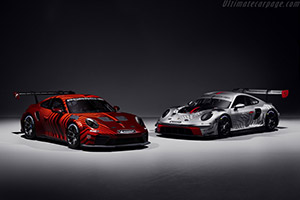
<< Prev Page 2 of 2  The water-cooled, high-revving six-cylinder engine continues to rely on natural aspiration. The visceral-sounding 4.0-litre boxer engine remains based on the unit used in the Porsche 911 GT3 (911 GT3: Fuel consumption* combined (WLTP) 13.8 – 13.7 l/100 km, CO₂ emissions* combined (WLTP) 312 – 310 g/km, CO₂ class G , CO₂ class weighted combined G ). In its latest racing version, now delivering 382 kW (520 PS), it incorporates additional components from the series production engine, including flow-optimised individual throttle valves and camshafts with extended valve opening times. This design eliminates the need for a centrally positioned throttle valve, which in turn allows for the installation of an air restrictor – a requirement for competing in other motor racing championships. Despite the ten PS increase, the engine’s service life remains unchanged: it only requires an overhaul after 100 hours of track time. To comply with varying noise regulations depending on the racing series, circuit, and local regulations, three different exhaust systems are available. The water-cooled, high-revving six-cylinder engine continues to rely on natural aspiration. The visceral-sounding 4.0-litre boxer engine remains based on the unit used in the Porsche 911 GT3 (911 GT3: Fuel consumption* combined (WLTP) 13.8 – 13.7 l/100 km, CO₂ emissions* combined (WLTP) 312 – 310 g/km, CO₂ class G , CO₂ class weighted combined G ). In its latest racing version, now delivering 382 kW (520 PS), it incorporates additional components from the series production engine, including flow-optimised individual throttle valves and camshafts with extended valve opening times. This design eliminates the need for a centrally positioned throttle valve, which in turn allows for the installation of an air restrictor – a requirement for competing in other motor racing championships. Despite the ten PS increase, the engine’s service life remains unchanged: it only requires an overhaul after 100 hours of track time. To comply with varying noise regulations depending on the racing series, circuit, and local regulations, three different exhaust systems are available.A more robust four-disc sintered metal racing clutch now handles power transmission to the sequential six-speed dog gearbox. This upgrade allows the engine speed, previously limited to 6,500 rpm during a standing start, to be increased, further enhancing the acoustic theatrics at the beginning of a race. An automatic engine restart function has also been introduced. This activates as soon as the driver depresses the clutch pedal after an accidental stall. Additionally, a new stroboscope function on the brake lights now alerts following drivers, particularly during the start phase. This replaces the previous use of the hazard warning lights for this safety application. The braking system has undergone a comprehensive upgrade. The front axle now features 380-millimetre discs, with their cross-section increased from 32 to 35 millimetres. This change allows for larger cooling channels for self-ventilation, improving heat dissipation. The background to this development: By relocating the central water cooler to the rear of the boot, cooling air can now be directed to the brakes through the central front section. Additionally, the outer diameter of the brake disc hat has been reduced, increasing the friction surface between the disc and brake pad. This results in more efficient deceleration thanks to wider brake pads, improved durability during long-distance races, and a significantly extended service life for the individual components. The Bosch M5 racing ABS will now be fitted ex-works in all 911 Cup cars. It features enhanced data processing capabilities to interpret input from the new acceleration sensor, which offers additional signal detection. The advanced software can also alert the driver in the event of a leak in either of the two brake circuits. Additionally, the brake fluid reservoir has been enlarged, making it suitable for long-distance racing. Adjusted steering stops enable the electronically assisted power steering to achieve a tighter turning radius, making manoeuvring through narrow city streets easier. The increased steering lock also allows drivers to counteract oversteer in the 911 more effectively. On the subject of steering, the redesigned, now higher-quality multifunction steering wheel combines a more attractive design with practical advantages. For example, central rotary controls are used to adjust ABS intervention and traction control. The newly designed colour-illuminated control buttons improve the readability of the respective labels. The central control panel next to the seat remains easily accessible and operable for the driver, even during a race. It now features eight physical switches instead of ten. The button at the bottom right opens an additional menu page on the display, enabling a wide range of detailed settings to be adjusted from inside the car, including pit lane speed, exhaust mapping, and steering angle reset. This removes the need to connect a laptop and simplifies operations for the teams. Additional foam padding on the inside of the door crossbar offers extra protection for the driver’s arms, legs, and feet. Matthias Scholz, Director GT Racing Cars, explains: “The new 911 Cup stands out thanks to the extensive attention to detail that has gone into its development. It is stronger, faster, yet also more practical. Component service life remains unchanged – in some cases even extended – despite the increase in performance. Where appropriate, materials have been replaced with components containing a high proportion of recycled materials. Cockpit operations have been optimised, and a range of additional electronic features allows for broader application across different racing formats.” The upgraded electronics in the new 911 Cup also contribute to improved drivability. The TPMS (Tyre Pressure Monitoring System) now displays tyre air temperatures on the central dashboard display. A significantly more powerful GPS antenna replaces the previous infrared system, taking over lap time and position tracking. Proven features from its big brother, the 911 GT3 R, have also been integrated, including lap time measurement for pit lane passages and the “pre-kill” function, which automatically switches off the engine once the car comes to a standstill during pit stops. Additionally, a new electronic monitoring system for the fire extinguisher release unit now checks the charge level of the self-contained nine-volt battery. In developing the 911 Cup, Porsche Motorsport once again partnered with Michelin to create a new generation of tyres for the one-make cup car. Real-world testing was conducted at Italy’s Grand Prix circuit in Monza, the Lausitzring in Brandenburg, and Porsche’s in-house track at the Weissach Development Centre. Behind the wheel were three former Porsche Juniors: Bastian Buus, Laurin Heinrich, and Klaus Bachler, joined by seasoned racing driver Marco Seefried. << Prev Page 2 of 2 |
| Article | Image gallery (25) | Specifications |
| All Cars - Contact us - Privacy Statement - Top | © 1998 - 2026 Ultimatecarpage.com |