Page 1 of 2 Next >> When the Group B class was cancelled at the end of the 1986 season, the back-to-back World Championship winning Peugeot 205 was left obsolete. The Jean Todt run Peugeot Sport team was left with several options; they could build a new Group A car to continue in the World Rally Championship, or broaden their perspective and enter a new form of racing. The first option was discarded and the Group B cars were converted to race in events like Paris Dakar and the Pikes Peak Hillclimb. A change in the Group C regulations for Le Mans cars opened new prospects for the French manufacturer. The new '3.5 litre' regulations allowed Peugeot to enter sportscar racing with a clean sheet design without having to face thoroughly developed machines. Following the Formula 1 regulations, Turbo charged engines were banned and a displacement maximum of 3.5 litre was set. The thought behind this was that it could in the long run lure more manufacturers into F1.
Having never won the legendary event, Peugeot decided to use the Group B Championship winning momentum to take a stab at Le Mans and the associated World Sportscar Championship. A completely new engine had to be developed and the Peugeot engineers came up with a V10 engine with a rather unconventional 80 degree V-angle. It was one of the very first ten cylinder engines and helped set a trend in Formula 1. The rest of the 'SA35-A1' followed a familiar pattern with its light alloy construction and four valves per cylinder, twin cam layout. Mated to a six speed gearbox, the V10 was bolted as a semi-stressed to a Dassault Aerospace engineered carbon-fibre monocoque. If it wasn't for the two seater layout, the rolling Peugeot 905 LM chassis could easily be mistaken for a contemporary F1 racer. That fact was hidden by a fully enveloping body of which the nose shared some design cues with the road going Peugeots of the day.
Halfway through 1990 and some two years after the program was first announced, the Peugeot 905 was officially unveiled on the Magny Cours circuit. After a short development period, a single car competed in the final rounds of the 1990 World Sports Car Championship (WssC) in the hands of former Formula 1 drivers Jean-Pierre Jabouille and Keke Rosberg. It could not quite match the existing (old regulation) Group C cars for pace, but was quicker than the Cosworth engined Spices built to the same regulations. Sadly the 480 km debut race was cut short after just 22 laps when the fuel pump failed. With the 905 further developed and the old cars penalized, things looked bright for Peugeot in 1991, but not surprisingly the competition had also developed 3.5 litre racers. The TWR prepared Jaguar XJR-14 proved to be the quickest by quite a margin and the poor reliability again did not do the Peugeot any favours. A fluke win was scored at Suzuka but Le Mans turned out to be a disaster with the longest surviving car covering a mere 68 laps. Both cars were blisteringly fast in qualifying though and they started from the front row. Page 1 of 2 Next >>

 Ultimatecarpage.com
> Cars by brand
> France
> Peugeot
Ultimatecarpage.com
> Cars by brand
> France
> Peugeot
 Racing cars
> Group C / IMSA GTP
Racing cars
> Group C / IMSA GTP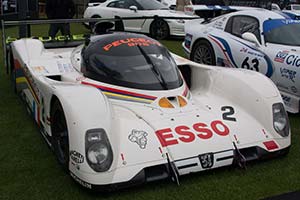
 When the Group B class was cancelled at the end of the 1986 season, the back-to-back World Championship winning Peugeot 205 was left obsolete. The Jean Todt run Peugeot Sport team was left with several options; they could build a new Group A car to continue in the World Rally Championship, or broaden their perspective and enter a new form of racing. The first option was discarded and the Group B cars were converted to race in events like Paris Dakar and the Pikes Peak Hillclimb. A change in the Group C regulations for Le Mans cars opened new prospects for the French manufacturer. The new '3.5 litre' regulations allowed Peugeot to enter sportscar racing with a clean sheet design without having to face thoroughly developed machines. Following the Formula 1 regulations, Turbo charged engines were banned and a displacement maximum of 3.5 litre was set. The thought behind this was that it could in the long run lure more manufacturers into F1.