Page 1 of 1 In the 1950s Europe's economy flourished, bringing about a complete restructuring of the roads, greatly improving the quality. This created the 'need' for faster, better handling cars known as Grand Tourers. Maserati recognized the potential and for the first time in their company's thirty year existence, they set about developing a real road car; the 3500 GT. In the past the Italian racing car specialist had produced small runs of road cars, but they were nothing more than thinly disguised racers. The new machine would have to combine the finesse and poise of the marque's racing cars with the luxury and quality demanded by the high-end market.
Maserati did not have look far for the 3500 GT's running gear. The six cylinder engine was directly derived from that of the 350 S sportsracer, which was based the engines in highly successful 250 F single seater and 300 S sports racer. Tamed down for street use and reliability, the twin-spark engine produced a healthy 220 bhp. Thanks to its 'oversquare' bore/stroke ratio, the 3.5 litre engine also produced an abundance of low-end torque. Mated to a four-speed gearbox, the 'six' was mounted in a tubular chassis. In good Italian fashion, stopping power was provided by drum brakes all-round.
Unlike the previous road going Maseratis, the 3500 GT was going to be offered as a complete model, so Maserati's engineers had the control over every bit of the car for the first time. For the interior and other trim Maserati's chief designer Ing. Giulio Alfieri spent a lot of time looking at British manufacturers and suppliers. The end-result was a very well appointed interior that offered room for two adults up front and two children at the back. Alfieri commissioned various Italian coachbuilders to draw up designs for the 3500 GT, from which Maserati would pick the final version. At the 1957 Geneva launch an Allemano and Touring Coupe were shown. Touring's design was eventually chosen and production got underway later in the year and the first cars delivered early in 1958.
Maserati's gamble paid off as the 3500 GT proved to a big commercial success. That was really what the doctor ordered after the hugely expensive 1957 racing, which saw many of the Maserati Works cars destroyed. At the end of the season, the company withdrew from active racing to fully focus on passenger cars. Alfieri continued working on perfecting the 3500 GT by adding front disc brakes and Fuel Injection. A bigger development was the introduction of a convertible model on a shortened 3500 GT chassis. Again various coachbuilders had a go at penning a candidate, and this time the commission was granted to Vignale. The final design was pretty similar to the Touring coupe, which made the 'Spyder' easily recognizable as a 3500 GT. Series production began in 1960.
By 1963 the Maserati 3500 GT was showing its age, although technically it was still up to par with the best Ferrari or Aston Martin had to offer. Alfieri decided to replace the successful Grand Tourer with not one, but two models. Both were technically very similar to the 3500 GT and sported slightly larger versions of the six cylinder engine. The first of the two to be announced was the Sebring, which sported a 2+2 Coupe body penned by Vignale. The second was a strict two seater; the Mistral. This very elegant Coupe was designed by Pietro Frua. Later a Mistral Spyder was also added to the line-up. For a small racing car manufacturer it must have been a massive step to start series production, but Maserati succeeded with surprising ease. Eventually well over 2200 examples were produced; more than all previous Maseratis combined. Page 1 of 1

 Ultimatecarpage.com
> Cars by brand
> Italy
> Maserati
Ultimatecarpage.com
> Cars by brand
> Italy
> Maserati
 3500 GT
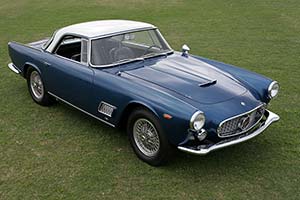
 In the 1950s Europe's economy flourished, bringing about a complete restructuring of the roads, greatly improving the quality. This created the 'need' for faster, better handling cars known as Grand Tourers. Maserati recognized the potential and for the first time in their company's thirty year existence, they set about developing a real road car; the 3500 GT. In the past the Italian racing car specialist had produced small runs of road cars, but they were nothing more than thinly disguised racers. The new machine would have to combine the finesse and poise of the marque's racing cars with the luxury and quality demanded by the high-end market.