Page 1 of 2 Next >> The history of the most famous pre-war BMW sportscar starts with the humble six cylinder engined 315 from 1934. Especially the 40 bhp sports version, powered by a 1.5 litre, three Carburetor version of the straight six was very successful in its class. In order to also make the car competitive in the below 2-liter class, BMW set out to develop a larger version of the engine, good for 55 bhp. Dubbed the 319, the two litre car looked identical to its predecessor and was again quite a car to beat on the track.
The new engine also became the first choice for a larger model presented in 1936, the 326. This was the first 'big' BMW and the 55 bhp gave the car only a moderate increase of performance increase over the 315 models. The two-seater cabriolet 327, which appeared a year later, could not match the performance of the similarly engined and nimbler 319s. Already at that time BMW drivers seemed to prefer performance over elegance and initial sales of the 327 were slow.
In the meantime BMW had anticipated some problems and developed a totally new cylinder head for the 6 cylinder. It used a valve train similar to the Riley and Talbot engines of the day, where one lateral camshaft through push-rods and rocker arms actuates the inlet and outlet valves. These are installed opposed (one on either side of the engine) in a hemispherical combustion room. Outwardly the engine looks like it has two overhead camshafts, but the covers just contain the horizontal pushrods for the valve drive. The modifications boosted the output of the engine by 25 bhp to a respectable 80 bhp.
The first car equipped with new engine was the 328 and it appeared to everybody's surprise at the 1936 Eiffel Rennen. In the capable hands of Ernst Henne it won the two litre class outright. It was immediately obvious that BMW had produced a winner. When it came on the market in 1937, the car was an instant hit and scored many victories in the hands of determined privateers. The standard roadster body was constructed in Eisenach, and came with a small textile cover. However other companies like Glaeser, Wendler and Drauz, offered more luxurious cabriolets as well.
Today the 328 is considered to be one the most modern pre-war cars. Its advanced chassis and light weight of just 830 kg makes a well driven example hard to catch even for much more modern machines. The design of the chassis was unique to this model. It used a tubular frame, with traverse strengthening, while suspension consisted of a transverse leaf spring at the front in combination with single lower wishbones. At the rear sat a live axle, sprung with two longitudinal torsion bars, which were to become a BMW hallmark. Page 1 of 2 Next >>

 Ultimatecarpage.com
> Cars by brand
> Germany
> BMW
Ultimatecarpage.com
> Cars by brand
> Germany
> BMW
 Racing cars
> Other Sportscars
Racing cars
> Other Sportscars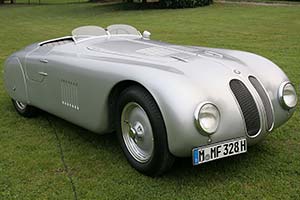
 The history of the most famous pre-war BMW sportscar starts with the humble six cylinder engined 315 from 1934. Especially the 40 bhp sports version, powered by a 1.5 litre, three Carburetor version of the straight six was very successful in its class. In order to also make the car competitive in the below 2-liter class, BMW set out to develop a larger version of the engine, good for 55 bhp. Dubbed the 319, the two litre car looked identical to its predecessor and was again quite a car to beat on the track.