Page 1 of 2 Next >> Although Porsche was racking up many class victories with the purpose built mid-engined sports racers, the company began to struggle in the production based GT class. One of the biggest problems was that the latest version of the 356 road car was considerably heavier than its predecessor. In a very rare move the German company reached out to third parties for help. The focus was on Italy where various racing car manufacturers and coachbuilders had been very successful in turning road cars into featherlight race winners. In September of 1960 Porsche teamed up with the old family friend and fellow Austrian Carlo Abarth to construct twenty new 356B based racing cars for the 1961 season, with an option for a further twenty cars.
The details of the deal were quite straightforward; Porsche would supply the 356B rolling chassis to Abarth, who in turn would complete the car with an Italian built and designed coachwork. Remarkably fitting an entirely new body did not affect the homologation as long as the complete car was not lighter as the minimum specified weight, which in the case of the 356B left plenty of room to spare. Although it was not specified in the agreement, Abarth ensured Porsche that the bodies would be made by Zagato, who were responsible for many of the successful GT racing cars.
Things are rarely straightforward in the automotive industry or in Italy for that matter. What Abarth failed to mention in the September 1960 meeting was that he was in fact in the process of ending his relationship with Zagato. For the Porsche project he employed former Bertone designer Franco Scaglione. At Bertone he had designed the futuristic BAT concept cars and was regarded as an aerodynamics expert. His design for the Porsche Abarth was somewhat unusual as it combined a sharp, low nose with a very short, round rear-end. Abarth commissioned master coachbuilder Rocco Motto of Turin to construct the bodies in aluminium.
Porsche supplied Abarth with the latest incarnation of the 356. The basic platform chassis design and all-round independent design was still very similar to the original introduced a decade earlier. Most of the development work had been carried out on the flat four engine. The chassis delivered to Abarth featured the latest 'Carrera' four-cam engine with a displacement of just under 1.6 litre. Derived from the successful racing car engines, the dry-sump, air-cooled engine produced a strong 115 bhp. For stopping power the Porsche still relied on hydraulic drum brakes, although the prototype Porsche Abarth was raced at various events with experimental disc brakes. Page 1 of 2 Next >>

 Ultimatecarpage.com
> Cars by brand
> Germany
> Porsche
Ultimatecarpage.com
> Cars by brand
> Germany
> Porsche
 Racing cars
> Other Sportscars
Racing cars
> Other Sportscars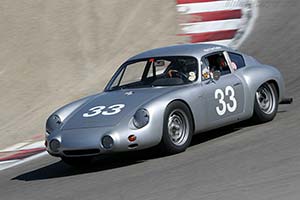
 Although Porsche was racking up many class victories with the purpose built mid-engined sports racers, the company began to struggle in the production based GT class. One of the biggest problems was that the latest version of the 356 road car was considerably heavier than its predecessor. In a very rare move the German company reached out to third parties for help. The focus was on Italy where various racing car manufacturers and coachbuilders had been very successful in turning road cars into featherlight race winners. In September of 1960 Porsche teamed up with the old family friend and fellow Austrian Carlo Abarth to construct twenty new 356B based racing cars for the 1961 season, with an option for a further twenty cars.