<< Prev Page 2 of 3 Next >> To the surprise of many, Aston Martin decided to construct a completely new Group C racer, half-way through 1986. For the third time an attempt would be made to turn the V8 engine into a successful sports car powerplant. Development of the brand-new quad cam version of the engine was handled by Reeves Callaway's Connecticut, USA based company. Development of the new car was headed by Ecurie Ecosse, who had previously scored two Le Mans victories with privately entered Jaguar D-Types.
When Ford's acquisition of 75% of Aston Martin Lagonda's stock was announced in September 1987, many feared for the future of the project. Ford did not interfere and in October 1988, the AMR1 was shown to the Newport Pagnell workers for the first time. Liveried in white, red and blue, the AMR1 featured sponsor markings of Mobil 1 and Goodyear. s/n AMR1 / 01 made its first run in November of the same year and it was ready to make its debut in 1989. Aston Martin officially returned to prototype racing, thirty years after the team's most successful season.
No expense was spared in designing the chassis for the AMR1. Chief designer was Max Boxstrom, a former Brabham employee. The coke-bottle shaped monocoque was constructed from very light materials; carbon fibre for the tub, kevlar for the skins and aluminium honeycomb for the floors. The most characteric exterior features were the large air ducts behind the front wheels, designed to get rid of the air from the large nose mounted wing. Suspension was by double wishbones all-round while stopping power was initially provided by steel vented and cross-drilled discs.
Early in April 1988, the V8 engines were running on the Callaway test-benches. The first engines displaced 5.3 litres, similar to the production version. Later in the year, a 6 litre version was ready. The first produced around 570 bhp and the second was good for 680 to 700 bhp in race trim. It was mounted semi-stressed and canted forward to make room for large underbody Venturis. Unusually, the radiator was mounted on top of the 5-speed gearbox and under the rear wing. << Prev Page 2 of 3 Next >>

 Ultimatecarpage.com
> Cars by brand
> Great Britain
> Aston Martin
Ultimatecarpage.com
> Cars by brand
> Great Britain
> Aston Martin
 Racing cars
> Group C / IMSA GTP
Racing cars
> Group C / IMSA GTP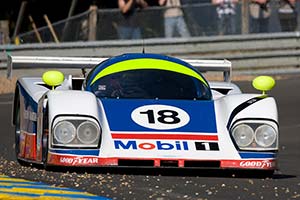
 To the surprise of many, Aston Martin decided to construct a completely new Group C racer, half-way through 1986. For the third time an attempt would be made to turn the V8 engine into a successful sports car powerplant. Development of the brand-new quad cam version of the engine was handled by Reeves Callaway's Connecticut, USA based company. Development of the new car was headed by Ecurie Ecosse, who had previously scored two Le Mans victories with privately entered Jaguar D-Types.