<< Prev Page 2 of 2 At the F3L's debut in the 1968 BOAC 500 at Brands Hatch, the two cars entered were far from ready to race. The first car had been tested briefly, but the second car was brand new and untried. In the first practice the car that had been tested dropped its engine and was out for the weekend. With Bruce McLaren at the wheel, the other car recorded the second fastest time. In the race McLaren took the lead, but 50 minutes into the race a driveshaft coupling failed, ending the race for the F3L. It nevertheless was a promising debut for the car that was obviously very fast, but needed more work to sort out the reliability issues.
One of the two cars was destroyed after hitting a hare in the practice for the next race, the 1000 km on the Nürburgring. The second car did not fair much better and after a series of problems, the engine stopped on lap three of the race. Highlight of the F3L's racing career was Frank Gardner's pole position at the Spa 1000 km a week later. He beat John Wyer Racing's, Jacky Ickx piloted GT40 by over 4 seconds. Again reliability problems let the car down in the race, this time after just one lap.
The F3L took part in two more races in 1968, but again its good pace was ruined by reliability issues. For 1969 an open top version was constructed, dubbed P69, which shared P68's cruel faith and never made it to the starting grid of a single race. The coupe covered just 14 laps of racing in 1969; it's engine failed after 14 laps at the BOAC 500 and it was pulled of the grid of the Silverstone Martini Trophy with a misfiring engine. This was a sadly a fitting end to the short-lived career of the red and gold racer.
Money problems and Ford's reluctance to put a real effort into the F3L make the strikingly beautiful racer one of motorsport's biggest could-have-beens. When it worked properly, the F3L was blisteringly quick, unfortunately it will be remembered as the racer that failed to finish a single race. The DFV engine did eventually become successful as a sports car engine, winning at Le Mans in 1975 but ironically in the back of the John Wyer Automotive developed Mirage. << Prev Page 2 of 2

 Ultimatecarpage.com
> Cars by brand
> United States
> Ford
Ultimatecarpage.com
> Cars by brand
> United States
> Ford
 Racing cars
> Other Sportscars
Racing cars
> Other Sportscars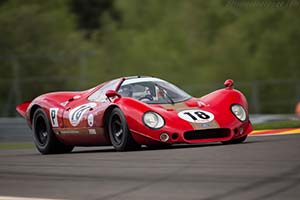
 At the F3L's debut in the 1968 BOAC 500 at Brands Hatch, the two cars entered were far from ready to race. The first car had been tested briefly, but the second car was brand new and untried. In the first practice the car that had been tested dropped its engine and was out for the weekend. With Bruce McLaren at the wheel, the other car recorded the second fastest time. In the race McLaren took the lead, but 50 minutes into the race a driveshaft coupling failed, ending the race for the F3L. It nevertheless was a promising debut for the car that was obviously very fast, but needed more work to sort out the reliability issues.