
 Ultimatecarpage.com
 News archive News archive
|
News Archive
| 2026 | 2025 | 2024 | 2023 | 2022 | 2021 | 2020 | 2019 | 2018 | 2017 | 2016 | 2015 | 2014 | 2013 | 2012 |
| December | November | October | September | August | July | June | May | April | March | February | January |
2009-10-30: The first ever Abarth and a limited edition Callaway Camaro ...
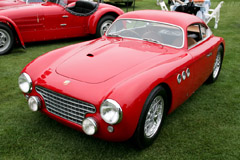 Today Abarth is best known for its modified Fiat models but amidst modifying other manufacturers' cars, the Italian tuning expert also built complete cars. The very first was this 205 Vignale Berlinetta, which was driven to a debut class victory in the 1950 Coppa InterEuropa at Monza. The small coupe combined Fiat mechanicals with a bespoke platform chassis and a Giovanni Michelotti-penned Vignale body. Two cars were raced in the major Italian events in 1950 with mixed success. After a third example was built early in 1950, Abarth withdrew from racing and concentrated on their hugely popular tuning kits. Quite unusual for cars of this era, all three have survived. The first was fully restored in the 1980s and has been a regular at shows ever since. At the Goodwood Festival of Speed the second chassis made its debut after a thorough restoration to rectify numerous modifications made during its long racing career. We expect to see the third car in the very near future in restored condition as well. For now we have a compiled an 18-shot gallery of the first two to illustrate the model's general history and a detailed look at the individual chassis.
Leading NASCAR team Hendrick Motorsports celebrates it 25th anniversary this year. To mark the occasion, Callaway Cars have produced a limited edition Hendrick Motorsports 25th Anniversary Camaro. Based on the stock Camaro SS, it features an Eaton supercharger that boosts the power to a hefty 582 bhp. The modified Camaro can accelerate to 60 mph in 3.9 seconds and is capable of completing the quarter-mile in under 12 seconds. The first of 25 examples will be shown next week during the SEMA Show. |
2009-10-28: Two Alfa Romeo engined racing cars with mixed success and very clean Scirocco racer ...
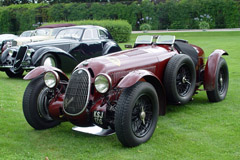 During the 1930s the eight-cylinder engined Alfa Romeos won all major races in Europe multiple times. Especially on home turf, in the grueling Mille Miglia Alfa Romeo was nearly unbeatable. An 8C 2300 scored its first win in the 1000 mile race in 1932 and an 8C 2900B claimed victory as late as 1947. There are two distinct generations of the 8C model, the second of which was the 8C 2900 launched in 1936 with an enlarged engine and independent suspension. For that year's Mille Miglia, the Scuderia Ferrari team entered four examples of the new version. This 8C 2900A Botticella Spider was driven to victory by Antonio Brivio. At the end of the season it was renumbered and sold as a road car. A new racing car with the same chassis number was built for the 1937 edition and won again. So much to the historians' delight two different 8C 2900As with the same number won the 1936 and 1937 Mille Miglias. Simon Moore, the foremost historian of 8C Alfas, revealed the full history of the featured example and accordingly it was restored back to its Mille Miglia winning configuration.
During the 1970s Alfa Romeo's racing record was a little more varied but the Italian manufacturer did manage to win the 1975 World Sportscar Championship in great style with the 33 TT/12 Spider, powered by a three-litre flat-12. A year later that same engine was supplied exclusively by Bernie Ecclestone's Brabham Formula 1 team. The purpose built BT45 did not prove quite as successful. Its similarly engined successor did manage to win two Grands Prix. Only very few Brabhams of the 'Bernie era' have made it into private hands but at least one of the BT45s has. Fully prepared for historic racing, the Alfa engined Brabham was captured by us during the 2008 Monaco Historic Grand Prix. During this weekend's season finale of the DTM championship Volkswagen launched the all new Scirocco Cup. Replacing the existing Polo Cup, it will be used in a one-make series to support the DTM races from 2010 onwards. Running on compressed natural gas, Volkswagen claim it is one of the cleanest racing cars out there today. |
|
2009-10-26: 2009 FIA GT Zolder report and slideshow ...
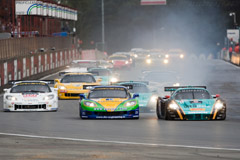 Yesterday the 13th FIA GT Championship came to a close at the Belgian Zolder track. In a weekend with ever changing weather the GT1 and GT2 drivers' titles were decided. It was a very close battle between Maserati and Corvette in the top class and the umpteenth encounter between Ferrari and Porsche in GT2. The exciting showdown was not only the final race of the season but also the last FIA GT race held in this form. Next year a new generation of GT1 cars will race in a new World Championship, while GT2 machinery will fight in a European Championship. Two cars built to the 2010 regulations already took part in several of this year's races in preparation for the World Championship. At Zolder both the Nissan Nismo GT-R and the Matech-Ford GT1 took to the track.
As a warm-up the spectators were also treated to two rounds of the European GT3 championship, which incorporated the Belgian GT championship. After a huge pile-up at the previous race, the entry was down but there were still plenty of spectacular GT races to enjoy. Among them were the latest additions to the grid like the Alpina B6 GT3, Audi R8 LMS and Morgan Aero SuperSports. Fortunately there were no repeats of the Paul Ricard accidents despite the ever changing weather conditions. Although we have only rarely reported on the FIA GT Championship, we could not bare to miss the 132nd and final race in the great GT racing series. We braved the weather to capture all the excitement and intrigue in a full report and a 100-shot gallery. |
2009-10-23: The last victorious Penske, turbocharged F1 racer and a Mopar Challenger headed for SEMA ...
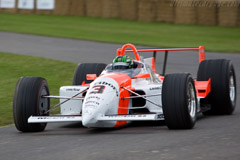 For many years years Roger Penske's team successfully campaigned Indycar racers of their own design while almost the entire field used customer chassis. It very often gave Team Penske an edge but in the second half of the 1990s, the package of the Penske chassis, Mercedes-Benz engine and Goodyear tyres gradually lost its edge. There was a brief return to form in 1997 when Canadian Paul Tracy scored three consecutive victories in the Penske PC26. His third win was Team Penske's 99th but it would take several seasons and a switch to a Reynard chassis for Penske to score his 100th win in Indycar racing. In recent years the chassis used by Tracy to score that 99th win, at St. Louis, was fully restored by Paul Morgan's Dawn Treader Performance. Last year Tracy was reunited with 'his' PC26 during the Goodwood Festival of Speed. This gave us the opportunity to take a closer look at the last victorious Penske.
At this year's Festival of Speed our attention was grabbed by this Beatrice-Lola THL1 Hart. Funded by the Beatrice food company and headed by Carl Haas, the project combined an all-star team of designers and drivers but yielded little results. Various former McLaren employees were involved and also a young Ross Brawn, while 1980 World Champion Alan Jones was signed to drive the red, white and blue cars. The THL1 debuted in 1985 and used a Hart engine in anticipation of an all new Ford V6. Before the project could flourish, Beatrice ended its support and the cars were not raced after 1986. The Beatrice-Lola we saw has been fully restored and has since been raced several times in historic events. Early next month, the SEMA show will spice up Las Vegas once again. One of the stars on the Chrysler booth will no doubt be this Mopar Challenger. Powered by the legendary 426 HEMI engine, it is dubbed the '1320' in reference to the number of feet that make up the quarter-mile. |
|
2009-10-21: Tokyo Motor Show: Lexus LFA finally revealed and a very dark Lotus Exige ...
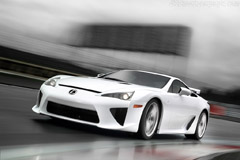 Earlier today the Tokyo Motor Show opened its doors to the international media. Not surprisingly, all eyes were on the long anticipated Lexus LFA.
The V10 engined supercar was first shown in Concept form at the 2005 North American International Auto Show in Detroit. Since then the car has been subjected to a very public developed program, which included several outings in the grueling N�rburgring 24 Hours event. This very thorough process has resulted in the LFA launched this morning in the Japanese capital. While most concept cars are toned down ahead of entering production, the Lexus designers have taken the styling one step further by including many striking cues like the air-intakes on the c-pillar. The boldly styled machine is constructed completely from lightweight and very strong carbon fibre composite plastics. Power comes from a 4.8 litre, naturally aspirated V10 engine that was jointly developed with Yamaha and produces just over 550 bhp and 480 Nm of torque. This is transferred to the road through a paddle-operated six speed gearbox. To give the LFA a near perfect weight-balance, the radiators have been mounted in the very tail of the car. Production of the Lexus LFA is limited to just 500 examples. A Roadster version of the concept was shown last year but it is not known whether that will be produced as well. The Tokyo Show is dominated by Japanese manufacturers but there are some notable exceptions; this year Lotus is one. The British manufacturer has just revealed the very dark Exige Scura. Production of this model is limited to just 35 examples world-wide. It is based on the Exige S but has been further lightened and comes with the most powerful version of the Toyota sourced engine. |
2009-10-19: BMW V12 LMR and Mercedes-Benz CLR; the best and worst from the 1999 Le Mans ...
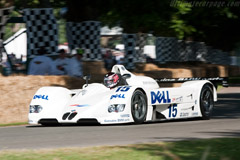 With factory efforts from Audi, BMW, Mercedes-Benz, Nissan and Toyota, the 24 Hours of Le Mans had one of its strongest fields in 1999. Mercedes-Benz and Toyota brought closed cars, BMW and Nissan open prototypes and at the company's first attempt Audi sampled both options. At the end of the race BMW and Mercedes-Benz had to share the headlines but for two very different reasons. In the tenth anniversary year we take a look at both cars and find out why.
The V12 LMR BMW brought to Le Mans was developed jointly with their future Formula 1 partner Williams. It featured an evolution of the V12 engine that had already won Le Mans outright in the back of the McLaren F1 GTR a few years earlier. The team arrived in France fresh off a win in the grueling Sebring 12 Hours, so they were well prepared. The car was not the absolute quickest in the field but managed to stay in the wake of the leaders despite being able to run as much as two laps longer between stops. The #17 example piloted by the likes of Lehto and Kristensen look set to clinch the win until a stuck throttle caused a big crash in the Porsche Curves. Fortunately the second car was also in contention and scored BMW's first outright win at Le Mans. The winning car was at Goodwood earlier this year to mark the 10th anniversary of the win. The real story of the 1999 Le Mans, however, was the Mercedes-Benz CLR. The low-drag coupe had some serious aero-problems that cause the car to flip on the long straights once in qualifying and again in the warm-up. Despite the obvious design flaws the Mercedes-Benz team risked its driver, the marshals, the spectators and public humiliation by allowing the two surviving cars to start. The inevitable happened and on live television Peter Dumbreck's CLR took off and flew into the trees. It's a miracle nobody got hurt in any of the accidents. The other car was withdrawn and that was the end of Mercedes-Benz at Le Mans. The video of Dumbreck's aerobatics is still very popular on Youtube. It was long believed that the only CLR left was quietly crushed in attempt to wipe the 1999 Le Mans from memory in Stuttgart. So we were very surprised to see it earlier in year and actually running on a track during the Modena Trackdays. Even more baffling is the fact that the car was actually sold to a customer. We captured every detail of CLR chassis 003 during this very rare and welcome opportunity. |
|
2009-10-16: Striking Veritas RS III finally revealed and the last purpose built Jaguar IMSA GTP racer ...
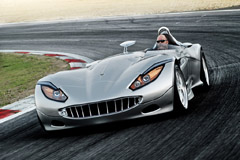 Originally launched as a concept car almost a decade ago, the reborn Veritas was destined to become yet another one-off. That changed last year when the rights were bought by Michael Trick's Vermot AG. He picked up the development work and recently the production Veritas RS III was launched to much acclaim. Like its original namesakes, it uses a BMW sourced drive-train. To be more specific, the V10 engine and SMG 7-Speed gearbox that are also found in the BMW M5 and M6. A six-speed manual will be an option. The 507 bhp V10 is installed in a lightweight space-frame chassis, which is clothed in a '1+1' body. There is a room for a passenger but just like on many 1950s sports racers, the passenger area can also be covered to improve the airflow. Thanks to its light weight, the aggressively styled Veritas can accelerate to 60 mph or 100 km/h in just over 3 seconds. The top speed is an equally impressive 216 mph or 347 km/h. The hand-built sports car takes 8 weeks to complete and the company expects to deliver the first cars in January of 2010.
In the early 1990s some of the fastest racing cars ever competed in the IMSA GTP Championship. Thanks to highly sophisticated ground-effects aerodynamics and immensely powerful turbocharged engines, they set a pace that has not been matched since on some of the tracks. Amidst the American built Japanese power-houses Nissan and Toyota, the TWR Jaguar team managed to score quite a few victories with adapted Group C designs in 1989 and 1990. For 1991 TWR developed the XJR-16, which was the company's first and as it would turn out to be only purpose-built GTP racer. Compared to the earlier twin-turbo, V6 engined Jaguars, it featured a revised rear-end and an innovative twin-tier rear wing. In the hands of Davy Jones, the XJR-16 had a perfect debut with a pole position and a victory. It would win another three times but sadly the program was abandoned before the XJR-16 could be fully developed. The car scored one of its four wins at Laguna Seca in July of 1991. To complement the XJR-16 feature, our friend and GTP nut Marshall Pruett has just uploaded videos of four other GTP races at Laguna Seca on his fabulous website GrandTouringPrototype.com. |
2009-10-14: Spectacular Grand Prix Bugatti in a designer suit ...
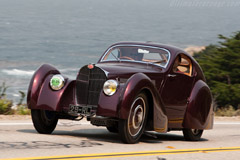 Today it seems hard to imagine but in the 1930s it was fairly common to have a Grand Prix racer re-bodied for road use at the end of its career. Usually fitted with very luxurious coach-work, these converted racers were really the first supercars, combining style with high performance. The 'recycling' of racing cars was particularly popular in Italy but there are also several Grand Prix Bugattis that have been re-bodied. At the recent centenary celebrations of the legendary marque one of these very rare cars took center stage by winning the 'Bugatti - 100 Years of Style and Speed' class. This was the Type 51 brought by the Nethercutt Collection.
The car started life in 1931 as one of the Works Grand Prix cars and it was subsequently owned by famous French racing drivers Louis Chiron and Ren� Dreyfuss. Later in the decade the car passed into the possession of a Parisian playboy, who had local coach-builder Dubos fit the Type 51 with a brand new 'designer suit.' The resulting Coup� was almost a miniature version of the highly acclaimed Type 57SC Atlantics, which to this day rank as the most sought after of all Bugattis. In the 1950s the chassis and body were separated but fortunately both have survived long enough to be reunited nearly 50 years ago. A full restoration was completed in 2003 after which the unique Type 51 Dubos Coup� was entered in many of the major shows across the United States. In 2004 it was awarded best of show during The Quail, a Motorsports Gathering. Especially for Bugatti's 100th anniversary celebrations, the Type 51 was restored once more. It returned to Pebble to claim best in class. Our detailed article includes the spectacular machine's full history and is illustrated by an 18-shot gallery with pictures from 2004 and 2009. |
|
2009-10-12: New E 63 Estate, massive Daimler Double Six, latest Noble and Nissan concept ...
 Mercedes-Benz completed the roll-out of the latest generation of the E-Class today with the release of the E 63 AMG Estate. The high performance version of the company's biggest estate uses the familiar 6.3 litre V8, which produces a hefty 525 bhp, and the latest 7-speed automatic gearbox. This enables the car to accelerate to 60 mph and 100 km/h in well under 5 seconds. The new E 63 AMG Estate will hit the showrooms in February of 2010.
An 'estate' of a completely different order is this Daimler Double Six 50 Landaulet. Built in very small numbers between 1926 and 1936, the Double Six Daimler was particularly popular with royals and heads of state around the world. This particular example was ordered by a Sydney based aristocrat, who registered the car with the license plate '1'. It remained in Australia for many years and has subsequently been part of major American and Japanese collections. The current owner had the Daimler completely restored and showed it at Pebble in August. The imposing Landaulet completed the Tour and scored a third in class. After a lengthy development period, Noble have finally launched the M600, which will replace the current range of M12 based models. Its most important new feature is the Volve derived V8 engine. Thanks to the use of twin turbochargers, it produces a ground shaking 650 bhp. Combined with the low weight of just 1275, this enables to the M600 to rival the best high-end sports cars from Germany and Italy. Production will commence early in 2010. Every Japanese manufacturer is gearing up to next week's Tokyo Motor Show. The latest company to join the fray is Nissan, who will show this highly unusual Land Glider Concept. Much like the Carver One, the two-seater features a 'tilt' system that allows the narrow machine to lean into the corners. Interestingly, Nissan have left the option of a production version of the Land Glider open. |
2009-10-08: RM Auctions Automobiles of London preview; CLK-GTR Roadster, ATS 2500 GTS and more ...
 On October 28th RM Auctions will offer a fine selection of cars in their third annual Automobiles of London sale. Organised in association with local auctioneer Sotheby's, the event is held at the Battersea Park in downtown London.
Among the most spectacular lots are the only two right-hand-drive Mercedes-Benz CLK-GTRs built for the Brunei Royal Family. The rarest of the duo is this Roadster, which was completed in 2006 and is most likely the very last CLK-GTR built by HWA. Sold new for �1.3 Million, it is now estimated to sell for a fraction at �430,000-�500,000 despite having only covered 34 kilometres. One of our favourite entries is the ATS 2500 GTS, which was recently shown at the Pebble Beach Concours d'Elegance. Among its unique features is a three-litre version of the beautiful twin-cam V8 engine. The car comes with an entry for next year's Concorso d'Eleganza Villa d'Este and will be offered without reserve. This Fiat 8V Ghia Coupe has already been an entrant in the prestigious Italian event. In addition to the Supersonics, this is the only other 8V bodied by Ghia. It features a very striking design penned by Mauro Boano. For collectors of early Rolls-Royces, the Automobiles of London auction offers two spectacular one-offs. The earliest is this Silver Ghost clothed by German coach-builder Schebera with a fabulous Skiff style body. Despite dating back to 1914, this Ghost has survived in remarkably original condition. In the 1920s Rolls-Royce built four experimental Phantom Is of which this Jarvis Torpedo is arguably the finest. After rigorous testing, it was sold to India where it remained for decades. More recently it was beautifully restored in Italy. |
|
2009-10-06: Toyota's spectacular FT-86 Coupe, German electric supercars and a new Abarth rally car ...
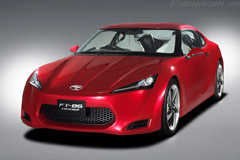 At the upcoming Tokyo Motor Show, Toyota will prominently showcase the FT-86 Concept. The compact sports car features a Flat-4 supplied by Subaru, a six-speed manual gearbox and best of all; rear-wheel drive. The styling is clearly inspired by the FT-HS Concept, which was first seen at Detroit's North American International Auto Sshow early in 2007. The production car will be dubbed 86 (pronounced hachi roku), which is a direct reference to the legendary AE86 built in the 1980s. The aptly named FT-86 (Future Toyota 86) should be followed by the final version in the next few months.
Early next year the very wild e-Wolf e-1 will hit the streets. Built in Germany, the minimalistic sports car features a single electric motor that produces 148 bhp and 250 Nm. That's enough to power the single-seater to 100 km/h in under five seconds. The motor is fed by Li-Tec batteries that can be charged very rapidly and give the car a range of around 300 km. A year later it is planned to be followed by the even more extreme e-2, which sports a fully enveloping body. It will come equipped with four electric motors that develop a combined 536 bhp and 1000 Nm of torque. The German company also has plans to develop racing versions of their unusual cars. At the recent San Remo Rally Abarth launched their latest racing car; the 500 R3T. The new offering from Fiat-Abarth is the off-road version of the Asetto Corse circuit racer. Like all Abarth 500 variants, the small rally car uses the 1.4 four cylinder engine fitted on this occasion with the latest Garrett turbo. The pocket rocket weighs 1080 kg and packs a 180 bhp punch. |
2009-10-05: Adrian Newey: a look back at three great designs by F1's current man of the moment ...
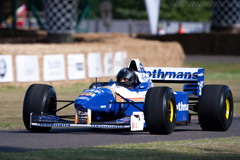 Yesterday Sebastian Vettel scored Red Bull Racing's fourth win of the season with the Adrian Newey penned RB5. The quality of Newey's design is underlined by the fact that the similarly engined Renault works team has not been close to winning a race once this year. To celebrate the hugely talented Englishman's already lengthy career, we today take a closer look at three distinct racing cars he was involved with.
Newey kicked off his career at March where he helped develop the manufacturers 1980s Group C and GTP cars. These were among the quickest machines in the IMSA GTP series until the arrival of the Porsche Works team in 1984. The winningest of all is this 83G Porsche, which was driven to numerous wins in the 1983 season and helped Al Holbert win the championship. At the start of 1984, chassis 83G/04 also took victory in the grueling Daytona 24 Hours race. Later in the decade Newey penned an unusually narrow single-seater for the return of March to Formula 1. By 1990 the team had been renamed Leyton House and campaigned the Newey designed CG901 Judd. It did not perform particularly well in the first half of the season, which was discovered to be down to a wind-tunnel calibration error. Newey developed a 'B-Spec' aero package but he could not enjoy the fruits of his labour as he was fired because of the poor results. In his absence the CG901B came achingly close to winning the French Grand Prix at Paul Ricard. Poor reliability saw both drivers slip from the lead of the race. The dismissal from Leyton House only helped Newey's career along as he was hired by Williams where he would go on to design multiple championship winning machines. One of them was the FW18 Renault, which was used by Damon Hill and Jacques Villeneuve to win 12 of the 16 races in the 1996 World Championship. Hill won the championship ahead of his team-mate and Williams clinched its fourth Contructor's trophy in five seasons. |
|
2009-10-01: From the land of the rising sun a howling Mazda racer and the first concepts destined for Tokyo ...
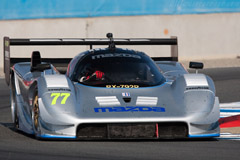 One of the most recognisable sounds around a racing track is the howl of Mazda's various rotary engines. These were raced with a lot of success during the 1980s and into the 1990s. In 1991 latest four-rotor 'Wankel' scored Japan's first win at Le Mans and dominated the IMSA GTO championship. These successes inspired the North American arm of the company to go all out and develop a GTP racing car for the 1992 season. With their ground-effects aerodynamics and hugely powerful engines, these GTP machines still rank among the fastest sports prototype racers ever constructed. Amidst fierce competition, Mazda fielded the RX-792P, which, as the name suggests, was inspired by the rotary-engined RX-7 road car. It suffered from some early problems that included the howling engine being too loud. Eventually the prototype racer came on song and scored some podium finishes. Sadly the program was halted at the end of the season as the supplies of engines from Japan dried up.
We were fortunate enough to shoot this RX-792P driven in anger for the first time in many years. The occasion was the Monterey Historic Automobile Races held on the aptly named Mazda Raceway Laguna Seca. Also on hand was Marshall Pruett, who recently launched the very addictive website GrandTouringPrototype.com, which is dedicated to this great era of racing. He shot some on-board footage of the RX-792P, which can be found at the bottom of the article. The bi-annual Tokyo Motor Show will open its door later in the month. It traditionally attracts very interesting concept cars from the nation's many manufacturers and this year's edition looks like it won't be an exception. Among Honda's various show cars is this CR-Z Concept, which should provide a very clear insight into the company's upcoming small sports car. With the Concept PX-MiEV and the Hybrid Concept, Mitsubishi and Subaru will showcase their intentions for a greener future. |
| All Cars - Contact us - Privacy Statement - Top | © 1998 - 2026 Ultimatecarpage.com |