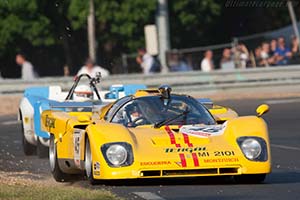
 The lowest numbered 512, chassis 1002 was presumably the prototype. It did not appear in races until June of 1970 when it was entered by Escuderia Montjuich in the 24 Hours of Le Mans. An accident ended the race early for the yellow and red Ferrari 512 S. For the remainder o>>>
|
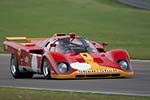 The ninth Ferrari 512 S off the line, chassis 1018 was sold new to German gentleman racer Georg Loos. From April 1970, the raced the car for two seasons, usually pairing with Helmut Kelleners and Franz Pesch. In only the car's second outing Kelleners and Loos secured a win i>>>
|
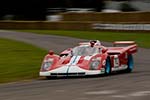 Originally a works car, chassis 1022 has had a complicated history. After two fruitless outings for the factory team, the car was handed to Corrado Manfredini to replace his damaged chassis 1032. For tax purposes the frame of 1022 was restamped 1032. Under its new identity t>>>
|
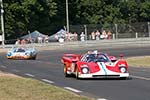 Originally completed as a 512 S, chassis 1024 was not sold until April of 1971. By that time it had been converted to the latest 'M' specification. It was bought by Dr Alfredo Belponer for the Scuderia Brescia Corse team. The car was campaigned numerous times that time by on>>>
|
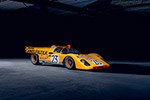 Sold new to Garage Francorchamps, this 512 was raced as an 'S' during the 1970 season by Belgian Hughes de Fierlant. He was joined by a choice of drivers including Derek Bell for the Spa 1000 km and Alistair Walker for the 24 Hours of Le Mans. The best result came at Le Mans>>>
|
 Originally sold to American amateur racers Chris Cord and Steve Earle, chassis 1040 was briefly raced as a 512 S in the United States. It was subsequently acquired by Kirk F. White and Roger Penske. They had the car rebuilt as a 512 M by the factory. Upon its return to the U>>>
|

 Ultimatecarpage.com
> Cars by brand
> Italy
> Ferrari
Ultimatecarpage.com
> Cars by brand
> Italy
> Ferrari
 Racing cars
> Other Sportscars
Racing cars
> Other Sportscars