2026-06-30: Michelotto modified Ferraris headed for RM Sotheby's auction ...
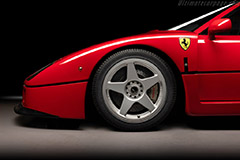
For the upcoming
Woodcote Park auction, RM Sotheby's have consigned a pair of Michelotto modified Ferraris. The earliest is this
Ferrari F40, which was originally owned by Jean Sage, who ran the F40 IMSA programme for French Ferrari distributor Charles Pozzi. Sage used the non-cat, non-adjust F40 on the road before he had it modified by Michelotto with competition components. Lighter and more powerful, it remained road-legal but was also briefly raced. Still in unique configuration,
chassis 84642 is now estimated to sell for £2,700,000 - 3,200,000.
The other Michelotto-modified Ferrari in the sale is this
360 GT. It had been built as a 360 Challenge car and used in this guise only once before it was rebuilt to N-GT configuration for the second owner. It was then raced in Australia and Europe during the 2002 and 2003 seasons. Following its contemporary racing career,
011M spent over a decade in a private, Melbourne-based collection. Restored to its 2003 Team Veloqx colours and still in full running order, it represents a relatively affordable way into historic racing a Ferrari at £350,000 - 400,000.
2026-06-26: Morgan Midsummer Coupe, Porsche 911 GT4 racer, and M3 and Diablo racers headed for auction ...

Morgan and Pininfarina have continued their collaboration with this striking
Midsummer Coupe as the result. Like the Roadster launched a few years ago, it combines the sophisticated bonded aluminium chassis with a Pininfarina design. As a closer look at the
Midsummer Coupe proves, this is a match made in heaven. Sadly, only nine examples will be built of the BMW-engined coupe.
In a break with tradition, the next generation Porsche GT4 racer will be based on the 911. To be more specific, the 992 II iteration of the 911 GT3. Dubbed the
911 GT4 R, it features a four-litre naturally aspirated six cylinder engine, which is mated to a six-speed sequential gearbox. The maximum output is 512 bhp but to balance the performance, intake restrictors will be fitted. Deliveries of the Cayman GT4
replacement will start in time for the 2027 season.
For the company's
annual sale on the Monterey Peninsula, Bonhams Cars has switched venues as it will now be held on the Raceway Laguna Seca circuit. Fittingly, the British auctioneer consigned several interesting competition cars. Among them is
Lamborghini Diablo GT, which combines the best of both worlds as it is homologated for the road but also ready to hit the track. The
example on offer has been fastidiously maintained and offered with around 12,000 km on the odometer. Also on offer is this
BMW M3 GT, which is the prototype for the E46-generation competition cars built for BMW by American specialists PTG Motorsport. Chassis
00-001 was raced extensively by PTG Motorsport during the 2000 season and continued to compete for several more seasons in the hands of customer teams.
2026-06-23: Koenigsegg One:1 headed for auction and new Bovensiepen 05 GT ...

For next weekend's
Tegernsee auction Anglo-Canadian company RM Sotheby's have consigned the most instantly recognisable of the six
Koenigsegg One:1s. Introduced a the 2014 Geneva Motor Show, the One:1 got its name for its 1 hp per kg power to weight ratio. The
consigned example is believed to be the third of the six production cars built and was finished a particularly striking colour combination of clear-coated carbon-fibre composite with pink accents. It has been regularly used and accrued over 4,000 km during the past decade. RM Sotheby's estimated that the next custodian will have to fork out at least €8 million to acquire
chassis 7108.
That same weekend, Artcurial will stage the official
Le Mans Classic Legend sale. The full, illustrated
lot list is now live and includes some striking cars like the unique, Gordon Murray designed
Duckhams LM Cosworth and the rare DFV-engined
Mirage M3.
Having sold the Alpina brand to BMW, the Bovensiepen family have created a new company much along the same lines. Their first production car is this
05 GT, which is based on the BMW M5. It packs more power, has improved handling characteristics and boasts an enhanced exterior design by renowned stylist Frank Stephenson.
2026-06-18: 2026 Spa Classic report and 200-shot gallery ...

The annual
Spa Classic is one of the absolute highlights on the historic racing calendar. The event traditionally welcomes superb grids to the legendary Circuit de Spa-Francorchamps, which is draped over the Belgian Ardennes. During the 2026 edition, the track did not live up to its reputation as we were treated to beautiful conditions throughout the weekend. There were changes on track as well as the second round of the Le Mans Classic Series saw the addition of two new race groups; the Heritage Touring Cup 2 for Group A touring cars and the GT3 Revival for 2006 - 2013 GT3 racers. These were part of the nine-grid strong roster that included night races on Saturday evening. Among the many highlights on track were a Gulf-liveried Porsche 917 K, a TWR Jaguar XJ-S and a freshly restored Audi R8.
Our photographers were on hand throughout the weekend to capture the
2026 Spa Classic in its entirety. The grid-by-grid report is illustrated by our exclusive
200-shot gallery.
2026-06-15: BMW M Concept Neue Klasse and Genesis Magma racer launched at Le Mans ...

In the build-up to the 24 Hours of Le Mans, BMW revealed the
M Concept Neue Klasse. As the name suggests it is BMW Motorsport version of the new Neue Klasse modular platform. Although no technical details have been revealed of the striking show car, it is a battery electric vehicle and uses the hugely sophisticated 'Heart of Joy' control system that is capable of handling 1,000s Nm of torque. The
M Concept Neue Klasse is not just concept car but is a preview of the upcoming production version due in the near future.
While making the marque's Le Mans debut, Hyundai's luxury arm Genesis also revealed the
Magma GT3 Concept. It is the competition version of the
Magma GT Concept unveiled late last year and signals a clear intent of expanding Genesis' motorsport activities. Technical details on both concept cars are sparse but they most like feature a mid-mounted V8 engine that is similar to the one powering the Le Mans Hypercar that competed at Le Mans this weekend. Time will tell if the Magma GT will enter production and if the GT3 version will join its bigger brother on the race track.
2026-06-11: News round-up with Audi Nuvolari and manual BMW M3 ...

During the Monaco Grand Prix, Audi revealed the all-new
Nuvolari. Named after the legendary Italian racing driver Tazio Nuvolari, it is not a successor to the R8 but the very first Audi hypercar. Power comes from a twin-turbo V8 that is assisted by three electric motors with a combined output of 1,001 metric horsepower. In good Audi tradition, an aluminium space frame chassis is used but clothed in a carbon-fibre composite body for the first time. Production of the 350 km/h
Nuvolari is strictly limited to 499 examples with the first deliveries expected early in 2027.
BMW North America will sound out the production of the sixth generation M3 with this very special
M3 CS Handschalter. As the name suggests, it is fitted with a six-speed manual gearbox instead of the eight-speed automatic found in the other M3 models. Rear-wheel drive only, the
M3 CS Handschalter has a base price of $107,100.
Replacing the original launched in 2022, Rolls-Royce have revealed the
Spectre Series II. As before, it is electric only and now has a range of well over 600 km. In addition to the standard model, Rolls-Royce also offers a 'Black Badge' version that has a slightly more powerful drivetrain.
Toyota's motorsport subsidiary Gazoo Racing has reworked the popular Corolla hatchback to create the
GRMN Corolla. Slated as the ultimate GR Corolla, it combines a 300 bhp engine with a six-speed manual gearbox and all-wheel drive. Sadly, the
GRMN Corolla will be produced in limited numbers and will only be available in Japan, Australia and North America.

 Ultimatecarpage.com